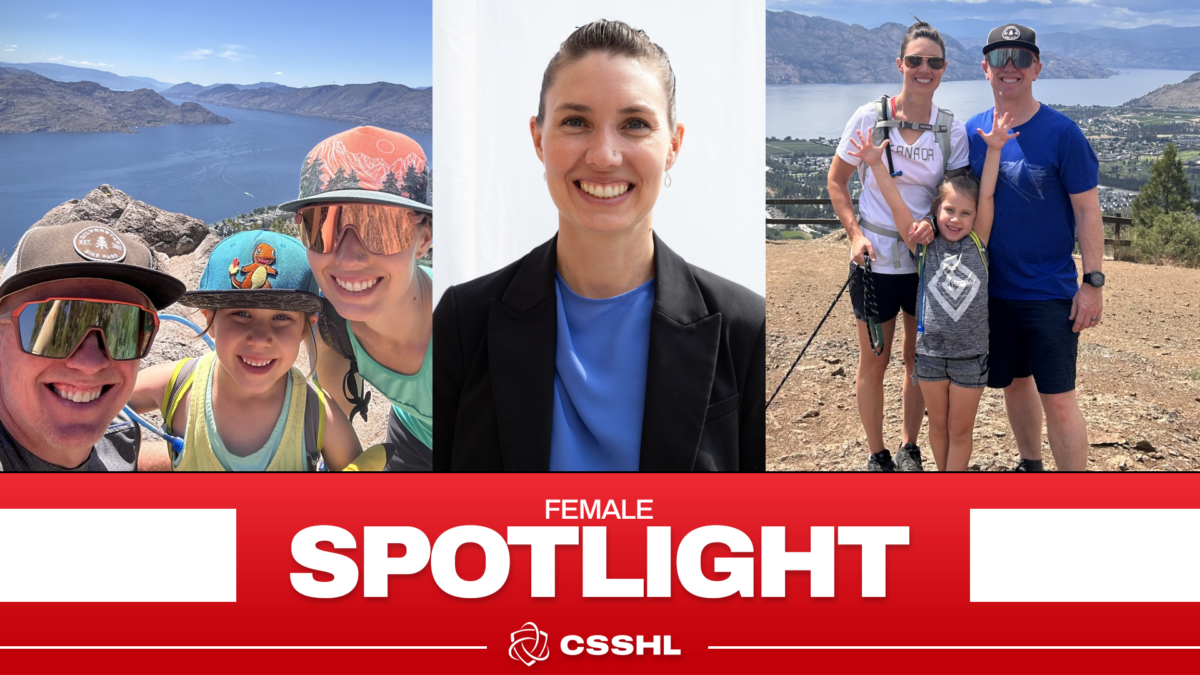
For Heather Perrin, hockey was never the sport she grew up playing. In fact, growing up in Burns Lake, B.C., hockey was just one of many possible avenues into sport — and eventually, into a career that would take her from small-town British Columbia to the Olympic stage and now, the General Manager’s office at the Okanagan Hockey Academy (OHA).
Perrin now lives in West Kelowna with her husband, Andrew, their six-year-old daughter, Georgia, and their dog, Merlin. Perrin has just completed her 11th year with OHA, where she began in 2014 as the academy’s Head Athletic Therapist. After eight years in that role, she transitioned into management, taking on a new challenge while remaining deeply involved in the hockey environment she has called home for more than a decade.
Perrin’s career began with a simple goal: she wanted to make a living in sport. She earned a Bachelor of Science with a major in Kinesiology from the University of Lethbridge before completing postgraduate studies in Athletic Therapy at Mount Royal College, earning an advanced certificate in Athletic Therapy.
She had been involved in sports her entire life, playing soccer, basketball, volleyball and rugby, while also competitively Highland dancing. She even joined her hometown’s volunteer fire department at 16 and spent time in South America on an exchange program, learning Spanish.
What connected those experiences was a desire to stay active and find positive ways to challenge herself. “I loved sport. I loved being part of a team,” Perrin said. “And I loved emergency medicine.” Athletic therapy provided a way to combine those passions.
Hockey eventually became the sport that offered the greatest opportunity to build a career. Perrin never played the game herself, but she began gaining experience around hockey while completing her education, working with university teams and accumulating the field and clinic hours required for certification.
Her first full-time hockey job came with Warner Hockey School. From there, she continued volunteering and working with Hockey Alberta, building both her experience and her network. That work eventually opened the door to Hockey Canada.
In 2010, Perrin was invited to a Hockey Canada camp in Calgary, AB. The camp brought together a large group of Athletic Therapists, and it also served as a selection opportunity. Perrin was selected to work with what was then Canada’s U22 program, beginning a relationship with Hockey Canada that would last for years.
Her involvement grew, and Perrin eventually worked at multiple world championships before reaching the pinnacle of international sport: the 2018 Winter Olympics in PyeongChang, South Korea.
That Olympic experience was the realization of a goal she had been pursuing for years. Her journey to that point was not simply about gaining experience. It was about continually putting herself in positions where opportunities could arise.
Although Perrin built much of her early professional network in Alberta, she always knew British Columbia was where she wanted to return. After working in Alberta and establishing herself with Hockey Canada, she made the move west, eventually settling in the Okanagan.
She worked with the North Okanagan Knights in the KIJHL and took on various contract opportunities while trying to establish herself in the region. She also worked as a kinesiologist while continuing to pursue opportunities in hockey.
Then came a familiar face and a timely opportunity. During Team Canada’s 2014 Olympic preparations in Penticton, Perrin spent time around OHA and reconnected with Christine Atkins, the academy’s head therapist at the time. When Atkins was preparing to leave OHA, she reached out to Perrin.
The opportunity proved to be the turning point. “I applied, and the rest is history,” remarked Perrin.
Leaving a secure job to join OHA proved to be one of the most important decisions of her career. At the academy, Perrin had the chance to lead a team of therapists and work with a large number of young athletes. It also gave her the flexibility to continue pursuing her Hockey Canada ambitions.
OHA supported her absences when she was away with national teams, sometimes for six to eight weeks in a year, and when she was selected for the Olympics, the organization granted her a leave of absence while keeping her position.
“That was huge for me as far as supporting that dream,” she said.
After eight years leading OHA’s Athletic Therapy program, Perrin moved into management. The transition has given her a new way to contribute to the organization and to the game itself.
“I’m in a unique and interesting time for myself,” she said. “I’ve sort of switched careers in a sense, moving out of Athletic Therapy and now into management.”
Perrin sees the transition as an opportunity to continue learning and growing. Rather than having a specific destination mapped out, she remains open to new challenges and opportunities. For someone whose career has been built by taking opportunities when they appear, that approach seems fitting.
Perrin’s career has also given her a perspective on what it means to be a woman working in hockey. Early in her career, she often felt pressure to avoid drawing attention to the fact that she was a woman.
She recalls applying for jobs using her full name, then removing her name and using only her initials on her resume. The response rate improved. For years, she said, she focused on not being noticed as a woman because she believed it could help her advance.
Now, she sees things differently. “I forgot that it was important to be a woman,” she said.
Perrin is increasingly comfortable recognizing that being a woman in hockey is not something to minimize, but something that can provide an important example for the next generation. That is especially meaningful as she looks at the girls coming through OHA.
“I think I’m starting to,” Perrin said when asked whether she sees herself as a role model.
One of Perrin’s greatest role models has been much closer to home.
Her mother raised Heather and her two siblings after the family lost her father in an avalanche when Heather was nine years old. Perrin watched her work tirelessly to provide opportunities for her family.
“She was certainly one of the most important influences in my life,” Perrin said. “She still is to this day.”
That example of perseverance and determination has clearly carried into Perrin’s own career. It is also reflected in the advice she gives to women looking to make their own way in hockey.
Perrin’s message to women entering hockey is straightforward: don’t wait for an opportunity to find you.
“If you want something, you have to go and get it,” she said. “Keep going. Find another way.”
That means pursuing opportunities, building relationships, working hard and continuing forward when obstacles appear.
For Perrin, networking has been particularly important. Hockey is a small world, she said, and you never know who you will meet or who might eventually play a role in your career. Her own career is proof of that.
A connection with Hockey Alberta led to an opportunity with Hockey Canada. A connection through Hockey Canada helped bring her to OHA. And a colleague leaving OHA created the opening that ultimately brought Perrin to the organization she now helps lead.
Perrin believes the growth of women’s hockey should extend beyond the players on the ice.
For her, one of the most important measures of progress is the number of opportunities available to women working behind the scenes — as coaches, therapists, managers and in other roles throughout the sport.
“The more staff that have opportunities to work in the game and make a living in the game, the more that as those players come through and they want to start to give back to the sport, they actually see a viable option,” she said.
She wants to see a future where women can build sustainable careers in hockey and use those careers to support themselves and their families. That future is already beginning to take shape, with more opportunities emerging throughout the women’s game. But Perrin believes there is still work to do.
For someone who once tried to hide the fact that she was a woman in hockey, her evolving role as a visible leader represents a significant change. And it is one she is embracing.
Perrin’s story is not one of someone who followed a perfectly mapped-out career path. It is a story of taking opportunities, building relationships, working hard and being willing to change direction.
She entered hockey without ever having played the game. She built a career in athletic therapy, worked with Canada’s national teams, reached the Olympics, returned home to British Columbia and eventually transitioned into management.
“Heather has been a major contributor to the success of Okanagan Hockey Academy during her time here,” said Oakes, President of OHA. “Whether it was in the medical department or in the management team she has made major contributions to our organization and to the student athletes she has worked with. She is a dedicated team member who is willing to always go above and beyond for the young student athletes that participate in OHA.”
Now, as general manager of Okanagan Hockey Academy, she is helping shape the environment for the next generation of athletes while continuing to find her own path forward.
She credits many people for helping her along the way, including Mel Davidson, who provided significant opportunities during her time with Hockey Canada, as well as Andy Oakes and Dixon Ward, who she says gave her opportunities that helped keep her in the game.
Ultimately, Perrin’s journey comes back to the same principles that have guided her since growing up in Burns Lake: stay active, keep learning, work hard and pursue opportunities.
“Someone will notice,” she said. “Somebody will give you a chance. You just have to keep going.”
For the girls coming through OHA, and for anyone hoping to build a career in hockey, Perrin is now both an example of that advice and someone helping create the opportunities she once had to chase herself.